Sports Injury Recovery and Performance: Why Function Matters More Than Pushing Through Pain
Sports injury recovery is about more than waiting for discomfort to settle. For active adults, student athletes, and recreational athletes in Monroe, Union County, and Indian Trail, a thoughtful plan can address how the joints, muscles, brain, and nervous system work together during movement. At Union Chiropractic Neurology, we use individualized, noninvasive care to help patients work toward improved movement quality and a responsible return to the activities they enjoy.
Whether an injury happened during practice, a weekend run, a workout, or a game, the goal is not simply to get back to doing more as quickly as possible. It is to understand what may be affecting control, mobility, balance, coordination, and confidence so progression can be appropriate for the individual.
Why Sports Injury Recovery Involves More Than the Injured Area
An ankle sprain, knee issue, shoulder irritation, or back injury can change the way a person moves. Sometimes the body compensates by shifting weight, limiting range of motion, or relying too heavily on another area. Those changes may affect the quality of a squat, jump, throw, stride, landing, or change of direction.
Joint rehabilitation can be an important part of care, but it is only one piece of the picture. A comprehensive approach to sports injury recovery may also consider mobility, strength, movement patterns, and how effectively the nervous system receives and uses information from the body.
The Role of Neurologic Control and Proprioception
Neurologic control refers to how the brain and nervous system help organize movement. Proprioception is the body’s awareness of where joints and limbs are in space. Together, they support the ability to react, stabilize, balance, and move with purpose.
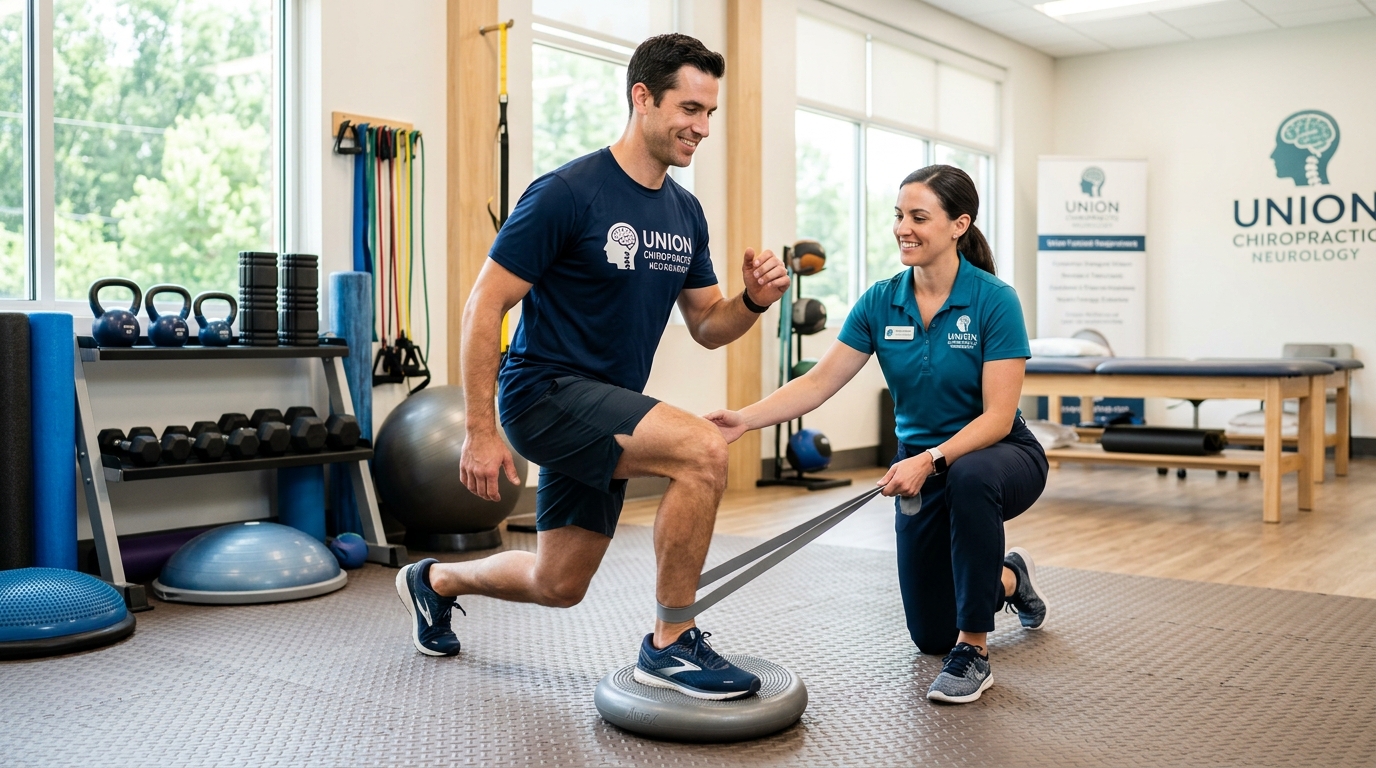
After an injury, proprioception and coordination may need attention even when daily activities feel manageable. For example, an athlete may be able to walk comfortably but still have difficulty controlling a single-leg landing, maintaining balance during a pivot, or coordinating a quick change in direction. These details can matter when preparing for sport or higher-level exercise.
At Union Chiropractic Neurology, functional neurology and neurorehabilitation principles may be used to assess and support the connection between movement, sensory input, and nervous-system control. Care is tailored to the person’s presentation, activity demands, and findings from a neurologic examination.
Balance, Coordination, and Mobility for Better Movement Quality
Good movement is not limited to flexibility or strength. It also depends on timing, control, and the ability to maintain stability while moving. Balance and coordination exercises may be helpful for athletes returning to running, lifting, field sports, court sports, or recreational activities.
Mobility also matters. When a joint does not move well, surrounding areas may take on extra stress. Addressing appropriate mobility and joint function can help create a stronger foundation for sport-specific movement. From there, rehabilitation can progress toward tasks that better reflect real-life demands, such as stepping, reaching, jumping, decelerating, or changing direction.
Individualized, Noninvasive Care in Monroe, NC
As a Monroe, NC chiropractor serving Union County and Indian Trail, Union Chiropractic Neurology takes an individualized approach to noninvasive healthcare. Dr. Louis Kerr and our team consider the whole functional picture rather than relying on a one-size-fits-all plan.
A functional evaluation may include discussion of the injury history, current symptoms, activity goals, joint mobility, balance, coordination, and movement quality. Depending on individual needs, care may include rehabilitative joint therapy, targeted neurorehabilitation exercises, taping or bracing, and other supportive noninvasive options. The purpose is to build a plan that fits the person—not simply the diagnosis or sport.
Progressing Back to Activity Responsibly
Returning to activity should be guided by symptoms, functional capacity, movement control, and the demands of the activity. There is no universal timetable for recovery, and no responsible provider can guarantee a return-to-play date. A gradual progression helps athletes and active adults test tolerance, build confidence, and identify areas that may still need attention.
- Start with movements that match current ability and comfort.
- Increase complexity gradually, from basic control to sport-specific tasks.
- Pay attention to balance, coordination, and quality—not only how much weight, distance, or speed is possible.
- Communicate changes in symptoms or concerns as activity increases.
- Work with appropriate healthcare and sports professionals when a coordinated return-to-activity plan is needed.
For athletes recovering from a concussion or experiencing symptoms such as headaches, dizziness, or vertigo, a more detailed neurologic evaluation may be especially important before increasing activity. Individual circumstances vary, and care should reflect the person’s symptoms, history, and functional needs.
Support for Active Adults and Athletes
Sports performance and injury recovery are not just for competitive athletes. If you enjoy training, hiking, running, cycling, golf, fitness classes, youth sports, or weekend recreation, better awareness of movement quality can support your long-term wellness care and activity goals.
Union Chiropractic Neurology provides evidence-based chiropractic neurology and functional rehabilitation for people in Monroe, Union County, and Indian Trail who want a noninvasive, individualized approach to sports injury recovery. Call (704) 776-8667 to schedule a functional evaluation.